Saturday, September 5, 2015

El Crucero de la Selva (The Jungle Cruise)


¡Buenos Dias!

The Water Taxi to Almirante
            On the fifth day in Bocas del Toro, Panama, we journeyed over to the mainland to spend the day visiting the San San Pond Sak Wetlands Reserve. We first traveled across the bay via water taxi to the coastal city of Almirante where we met two local taxi divers that shuttled us to the reserve. The city of Almirante was appealing because it was originally designed as a major port of banana exports, although out of commission today, the history and the indigenous people of the town are still very prevalent. While driving through the town on our way to the reserve, we got to see a part of Panama that we have yet to experience. The indigenous people of the Ngäbe-Buglé indians occupied the town of Almirante. We were able to experience some of the everyday activities they went about doing as they were either on their way to school, playing around in the grassy yards, or hard at work helping to raise and support their families.  I thought it was very interesting to see how the town functioned compared to the society in which we live and the similarities and differences amongst us. 

Homes in Almirante
San San Pond Sak Wetlands Reserve 
            After we passed through the city and crossed the mountains of the Changuinola region, we arrived at the San San Pond Sak Wetlands Reserve located on the upper part of the San San River. We were first introduced to a man named José, a local that has been working with the San San Pond Sak Wetlands Reserve for quite some time and knew a lot about the history and current status of the reserve. Shortly after, we learned that José did not speak any English and it would of made it very difficult for us to learn about the reserve if it wasn’t for the help of one of our classmates, Katalin Plummer, who was able to translate and relay the information to the rest of the group. Thanks to her, we started the tour off with a short introduction about the reserve and all that it does for the protected wetlands. We learned that the San San Pond Sak Wetlands is an internationally important protected area that focuses on the restoration of Panamanian forests, as well as the protection and restoration of local manatee and sea turtle populations.

José
            

           After the introduction, we all piled into a boat and headed down the river for the start of our tour of the reserve. As we cruised down the river, we were surrounded on both sides by dense walls of luscious green forest, full of wildlife. After being warned that we were not expecting to see any manatees in the river, we focused our attention on the animals of the surrounding forest. We were able to see lots of birds including some pelicans, swallows, and a few terns, as well as a couple of iguanas posting up in the treetops lining the river bank. The most exciting thing we got to see today was a three-toed sloth hanging around in the trees. We ended up seeing about a half dozen of them throughout the rest of the tour. This was the first sighting of a sloth that we have seen on this trip and I think it’s safe to say that it made everyone’s day because the group couldn’t have been more excited after witnessing the sloths!
Three-toed Sloth Hanging Out
            

          The first stop we made along the river was at a piece of land that was donated by the Chiquita Banana Company in 2009 for restoration purposes. A few years ago trees were planted across the land in order to help restore the forest. We wanted to walk back into the land but unfortunately, it had rained the day before and we quickly realized that the shoes we had were no match for the muddy area so we weren’t able to go too far. Instead, we gathered near the dock where a man, who turned out to be José’s father, showed us a few of the plants growing nearby; including some abnormally shaped square bananas. These were unlike any bananas I’ve ever seen before. With their unusual four-sided figure and much larger size, we didn’t really know what to expect; but after trying some we were amazed by how delicious they were.   
Square Bananas are a Bunch of Fun
Fresh Coconut Water for Lunch
            The last stop we made was at the site along the river, close to the river mouth, where the Leatherback Sea Turtles came to breed. Unfortunately, this was not the breeding time of the year for sea turtles so we didn’t get a chance to see any. Instead, we walked the beach for a short period of time and then took a break for lunch. During lunch we were given our own freshly cut coconuts from a local neighbor that we enjoyed while finishing our lunches. Afterwards, we packed all of our things, got back on the boat, and headed up the river for our departure back to STRI.  
Newborn Leatherback Sea Turtles
            After a bit of unwinding back at STRI, we concluded the night with the first nighttime snorkeling adventure. We suited up after dark at the STRI dock and headed into the water just beyond the dock. Fully equipped with our snorkeling gear and flashlights, we plunged into the water and snorkeled around for about 20 minutes. During the swim, we encountered tons of baseball-sized green sea urchins meandering around among the seagrasses. We also got to see a little puffer fish, a few Caribbean reef squids, and many grunt fish swimming about. We even encountered several box-jellyfish, called Sea Wasps, which were drifting along just below the surface of the water.  Due to the nasty, painful sting it can induce on a person’s skin, we decided to turn around and head back to the dock in order to prevent any incidents. Although the night snorkel was concluded early, the night snorkel adventure was by far one of the most fun and exciting snorkeling trips we’ve had.

Hope you have enjoyed reading about all of our incredible adventures in Panama thus far. 


-Craig Stuart

Thursday, September 3, 2015

Jueves en Panama

Greetings from beautiful Isla Colon, Bocas del Toro, Panama.

The group had quite a busy day today starting at 8 a.m. with our group projects.
Nicole, Craig and Morgan make up team "Damsels in Distress" who are studying the effect of enriching Damselfish (three-spot damselfish, Stegastes planifrons) territories with a fertilizer (to increase valuable algae growth) on behavior. Today they made good progress on the study by identifying all of their study sites and setting out fertilizer sticks.

Spotted Cleaner Shrimp
Alyssa and Katalin (team S.O.S.) started their day by snorkeling off the STRI dock doing a preliminary survey of target study species, which include the cushion sea star (Oreaster reticulatus) the variegated sea urchin (Lytechinus varigatus) and possibly the sea biscuit (Clypeaster rosaceus).
Lion fish


"The Cucumber Crew" is the team I belong to with my compadres Natasha and Katie. Our study is trying to determine if there is a difference in day vs. night activity and sediment type preference (food preference) in the two most abundant sea cucumber species here, the three-lined sea cucumber (Isostichopus badionotus) and the donkey dung sea cucumber (Holothuria mexicana) (Can you guess what this one resembles?).  Today we collected 16 sea cucumbers of each species  from House Reef and from the neighboring sea grass beds and set up a 15 meter diameter area marked with flags and glow in the dark fishing bobbers.  In the coming days we will tag every sea cucumber we have, place them all in the center of the transect and measure their diurnal movements every 12 hours for several days.
After a lunch break the group got back together and headed out to Cocos Point. This place was amazing. Right after we jumped into the water we found a large lion fish (an invasive species to this area). During our time on this reef members of the group discovered native lobster, many species brain and maze coral and one of the largest stingrays I have ever seen.
Southern Stingray
Staghorn Coral
At the second site of the day we found a magnificent stand of critically endangered Staghorn coral (Acropora cervicornis).  I spent a few minutes admiring this crop of coral and even found a basket star tightly wrapped around one of the branches.
Cushion Star.


The third and last site for the day was Mangrove Point, where the group found many Cushion stars and variegated urchins.

After five and a half hours of snorkeling and a short lecture on sea grasses, the gang (myself included) are calling this one very successful day in paradise and are very ready for some sleep.

This is MacKenna Hainey signing off from the Smithsonian Tropical Research Institute.
Thanks for reading.


Wednesday, September 2, 2015

El tercer día (the third day)

Look at that vase sponge.
(large cylinder, right)
Hola a todos from Bocas del Toro! My name is Katalin, and I’m here to give you an update on what sort of trouble we got into today! Please sit back and enjoy the next installment of OIMB Goes To Panamá. (For quick reference, in case you’ve forgotten from the previous blog posts, Richard and Jan are our UO professors that have come down to teach and lead this course.)

After a day or two of acclimatizing and familiarizing ourselves with our surroundings, we dove into the real science today (pun intended). Bright-eyed and bushy tailed, we headed out to the boat for a full morning of snorkeling and some “exercises,” as Jan and Richard called them. (Unfortunately, one of our team members, Nicole, wasn’t feeling too hot, so she stayed behind for the morning; we sent her good vibes so that she could jump back in with us ASAP.) Our fantastic boat driver decked out in his camouflage shorts took us out to a site called Cocos Point, where we found an exquisite coral reef (in my opinion — not as exquisite as I imagine it was years ago) that was positively filled with Millepora spp., or various species of fire corals. Rumor has it that skin contact with these beauties hurts like the dickens. You'll be pleased to know that my respect for the living creatures kept me from testing out the truth of this hypothesis (though my lack of courage also played a role in that decision, too). Anyways, it was on this reef that we completed our first exercise.
Millepora (fire coral, yellow branches) and
some Echinometra (black sea urchins). 
A common coral, Porites (green fingers) and
many little anemones, Zoanthus (blue circles).

Porites, the green coral, another Echinometra (or two??),
and a pretty sea anemone (the blue tentacles).


Using flags that Richard had set out, we worked in pairs to use a quadrat sampling method that helped us to ascertain the relative percent cover of particular species, especially corals, algae, and other common animals like sponges (yes, they are animals!). We photographed each of our quadrats (each pair had 5 total) and noted our estimations on slates. While this all may sound quite graceful, believe me when I say that it was indeed anything but. In reality, there was a lot of floundering around, a lot of swallowed seawater, a lot of bumping into and kicking partners, and a lot of struggling to stay in place. And don’t even get me started on writing underwater. Let’s just leave it at this: no real human walking this Earth can decipher what I wrote on my slate (I mean, I’m not even sure I can read it). When we got back on the boat, Richard and Jan sheepishly asked us how that activity went… we all broke out into laughter because the answer was obvious: underwater sampling is much more challenging than we had expected. It turned out that that was really the point of the exercise, alongside getting quality data to work with later. It’s not all rainbows and butterflies when it come to marine biology, something that we had already learned in other capacities, but I suppose it’s good to reinforce it in other avenues.


Zoanthus, the many little anemones, and a green algae
Halimeda (leafy green in the bottom right).
For our second exercise, we then headed over to STRI Point for some seagrass density sampling. As you can imagine, this one was even more clumsy, since we actually collected some seagrass shoots, and it was a sandy bottom. Here we experienced similar complications as in the first activity, including trying to stay underwater to uproot the shoots and trying to see through all the sediment that we had kicked up. Luckily, to make up for it, we got some extra snorkeling in after the activity, and saw a large clump of tree trunk fingers where a huge amount of brightly colored fish gathered. And, of course, Jan’s boat snacks always help diminish frustration and inflate positive moods.

Then, in the afternoon came the part where discoveries are made, hair is torn out (in a good or bad way, it all depends), and knowledge is truly gained: data compilation and crunching. (This happened after the “picture review”, where we go through all the photos that Richard took on our snorkel trips and he and Jan tag-team, teaching us about the various animals/algae depicted in the photos or quizzing us on names. I think this part of lab time is probably a crowd favorite.) Though it’s not quite as exciting as being in the field, lab time and data crunching are both just as important and certainly have their own place in the life of a scientist.
Porites again, and an octocoral or a soft coral
(yellow feathers, left).

Before coming to Panama, I knew that we would not have a great deal of down time, that our individual projects would present us with a substantial amount of challenges, and that we would be exhausted at the end of each day. While those are all possible sources of stress, we all maintain good attitudes and laugh quite often. I think that the key (or for any of my chilenos reading this, la mano) for this trip is to not get overwhelmed, and just try to keep your head above water (pun intended).

Besides, this is day 3. We have 10 days left. Vamos, que se puede! (“Come on, we can do this!”)

-Katalin

Tuesday, September 1, 2015

Second day of adventure in a rainy paradise

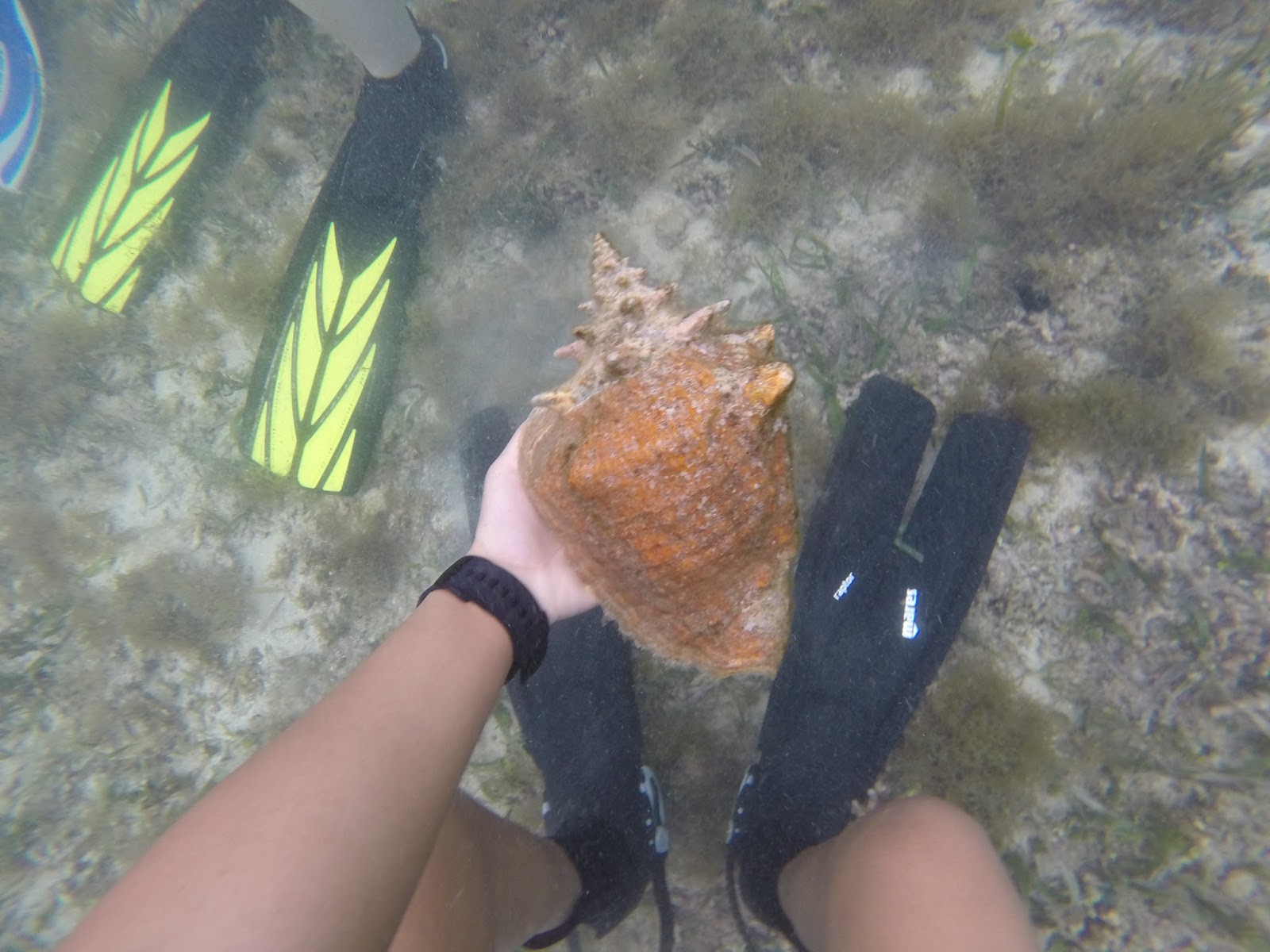
The Conch shell that MacKenna found
On our second day here at STRI we experienced rain, thunder and lightning. Despite the weather we went out snorkeling for half a day. Amulfo our boat driver took us to STRI point, Hospital point, and Mangrove point. At the first location we saw a lot of sponges, algae, and MacKenna even found a large sized Conch, which is extremely rare to find! This was the highlight of my day because I have seen many Conch shells but never in the water that size with a living snail!
Top view of the Conch shell 
There were so many different species of fish and invertebrates that we were able to get so close to making it such a memorable experience but also exhausting (since we were snorkeling instead of scuba diving). Thanks to Jan, one of the instructors, we could keep our energy up with her “boat snacks”. Some of us also learned quickly which organisms not to touch. For example, the Diadema antillarum was one not to go about touching because it contains venom that causes a painful sting.  

Diadema antillarum - a long thin spined urchin that was abundant at STRI point

The view of Hospital point (our second snorkel spot) 


Richard, the other instructor here with us cut some mangrove branches while we were out snorkeling for us to look at in the lab. We looked at all the organisms that were living on the branches and took count of how many were on each branch, identified the species present, and looked at some of the organisms under the microscope. It was so amazing to discover how many organisms could live on the mangrove roots and how small they are! Some organisms were so hard to see because mangrove forests provide habitat for many juveniles of different species so they were quite small.
Richard, Jan, Craig, Morgan, and Katie counting and identifying the organisms on the mangrove branches

Despite the gloomy weather, Bocas Del Toro was still beautiful looking out from the boat and being in the water. After our 7:30 p.m. lecture I think its safe to say our third day in Panama has come to an end.


P.S. As I am writing this I got interrupted to see the Caimen alligator right outside of the lab (now it has come to an end)!

Monday, August 31, 2015

3,420 miles.

We are 3,420 miles from the University of Oregon and reveling in the thrill that comes with new experiences!


Our trip to Panama started with many, many hours of airport travel. We all traveled to at least three airports and spent about 18-26 hours traveling around the world. Although we were exhausted when we landed in Panama, we were extremely excited to have reached our destination! It was exhilarating to look out of my window and not recognize any trees or landmarks, and to only be filled with curiosity about what lay below. It took a while for everyone to reach Panama, so those of us that arrived in the afternoon explored around our hostel with Richard Emlet, one of the two professors who coordinated this trip. We began to settle into the trip by taking in the sounds of a soccer game while we ate traditional Panamanian dinner (ceviche, seafood, and plantains…yum!) at a table overlooking the entrance to the Panama Canal. We then walked around the local neighborhoods before watching the sunset from the Panama Canal Administration Building. From our view atop the hill we could see planes, trains, cars, and ships interacting together in one panoramic view of the Canal Zone. It was quite spectacular!

The Canal Zone from above.
Pictured from left to right: MacKenna Hainey, Katie Medina, Natasha Coon,
Katalin Plummer, Craig Stuart, and Richard Emlet

A ship moving through
the Canal.
The first full day of the trip was spent taking in the complex metropolitan that is Panama City. We first visited the Miraflores Locks at the Panama Canal to watch the ships pass from the Pacific to the Atlantic Oceans. The walls of the locks separating the two sides of water are about 100 feet tall! I was stunned to learn that the technology of the canal was 100 years old and extremely efficient. The canal utilizes gravity to draw water in from another side of the canal in order to raise the massive ships to a level where they can be pulled safely along by trains. The fit for a boat is very tight, so ships are pulled through the canal with trains on tracks adjacent to the canal itself. It takes a full day to travel through the entirety of the canal and only 30 minutes to traverse one of the locks. To see the Panama Canal in action was a humbling experience.

There are no two sides of the museum that look the same!
The Biomuseo is a physical representation of Panama's
complexity and colorful personality.
We then continued to Panama City’s fish market and enjoyed a fresh seafood lunch while we took a reprieve from the stifling heat and humidity. Our amazing tour guide, Millie, drove us through Casco Viejo, an UNESCO World Heritage Site, in order to let us experience a little taste of Panama’s colonial architecture and history. The rest of the afternoon was spent at the Biomuseo, a recently opened museum dedicated to educating guests about Panama’s biodiversity through a combination of art and science. The museum was extremely colorful and utilized a wide range of media and educational tools to convey their messages of conservation and culture. My favorite part of the museum was learning from Igua, an exhibit interpreter who was passionate about paleontology and her Kuna Yala heritage, about how the Biomuseo acquired the only complete Marlin fossil in the world.

Colorful shrimp are displayed at the fish market.
We saw a variety of fish, octopus, lobster, snails,
and more for sale by persuasive vendors.
The most powerful moment from this trip for me was on our first day in Panama City. Picture this: you’re standing on a popular walkway along the water. The smells of sulfurous mudflats and freshly cooked fish waft through the air. You listen to families chattering in Spanish and street vendors call out to passerby’s, tempting them with cold water and snow cones on a tropical summer day. The clouds are countless shades of grey and birds (Magnificent Frigatebirds and Brown Pelicans) soar overhead as they look for their next meal. You take a deep breath, enjoying the fresh Panamanian ceviche and coconut rice from your lunch. When suddenly…distant but unmistakable rumbles of thunder. You look out towards the Panama City skyline to see magnificent lightning strikes lighting up the hundreds of skyscrapers in front of you. A thunderstorm hints at dumping its might on the bustling city, but no rain falls. Just laughter, a full belly, and a new country waiting to open its arms to you (even when you struggle to speak its language). All of the to-do lists and worries and nonsense and cares just leave your head as you embraced the moment you were living in. Most importantly, you suddenly realize, “This is what it’s like to live. I’m not thinking about me. I’m literally living in this moment.” Now what could be better than that?


Looking down at the reefs 30 feet below.
Today, we headed out of our hostel at 5 am to fly to our home for the rest of the trip, the Smithsonian Tropical Research Institute (STRI) in Bocas del Toro, Panama. As I sipped a much-needed cup of coffee on the plane, I was filled with exhilaration over finally seeing the clear green water, colorful Caribbean homes, and reefs I had dreamed about since I registered for this study abroad. After lunch and an orientation, we finally got to jump into the water and explore the reefs and mangroves next to STRI. We were surrounded by hundreds of species of mollusks, fish, crustaceans, cnidaria, echinoderms, porifera, and more. I loved getting to see my first wild coral and swim among the mangrove roots. I wished I had more heads to take in the sights around me as I snorkeled and swam through the warm tropical water! Although I wanted to see as much of the reef as possible, I made sure to take a moment to stop and observe as I sat in a gap between the mangrove roots. Colorful corals and sponges contrasted stunningly against the dark roots of the tree and schools of tiny green fish danced among the roots and my fins. The sun sparkled above while the seagrass danced below, and I could hear nothing but tiny waves and a light wind stirring the leaves of the mangrove trees. This is paradise.

Pictured below from left to right: 
Left: Different kinds of corals interact with each other and other organisms to form a beautiful example of symbiosis.
Middle: A sea biscuit test I found had some air left in it and became a sea balloon. :)
Right: Two Brain corals sitting in the sand, with aggressive damselfish watching nearby.

A Spotted Sea Hare (Aplysia dactlomela) munches on corals on the
sea floor sucking the sap from coral polyps.
A Caribbean Reef Squid (Sepioteuthis sepioidea) swims gracefully among the seagrasses near STRI.
Wonder is a word that keeps floating through my mind. I wonder how the culture differs from our own, and am humbled by the privilege our country grants us. I wonder how our original scientific projects will go when we reach the research stations. I wonder what kind of exciting food we will have at our next meal. I wonder how our friends and family are doing back home. I wonder how terrible my Spanish is. I wonder which sounds belong to which animal, and what organisms swim and crawl with me in the water. I wonder what the stories are of the people passing by. I wonder how we will change during our time abroad.

As I sign off, I am left with one more wonder: what adventures still await us in this beautiful country?

~ Alyssa ("Aly") Bjorkquist ~

Wednesday, August 5, 2015

OIMB Returns to Panama 2015

Students will study mangrove, coral reef and sea grass habitats
Students from the Oregon Institute of Marine Biology will be studying tropical marine biology and environmental issues at the Smithsonian Tropical Research Institute's Bocas del Toro Research Station in Panama during the first two weeks of September 2015.  Each day one student will write a blog entry detailing their activities.