Es Miercoles - que lastima! No hay más tiempo.
(Its Wednesday - oh no! There's not much time left.)
 |
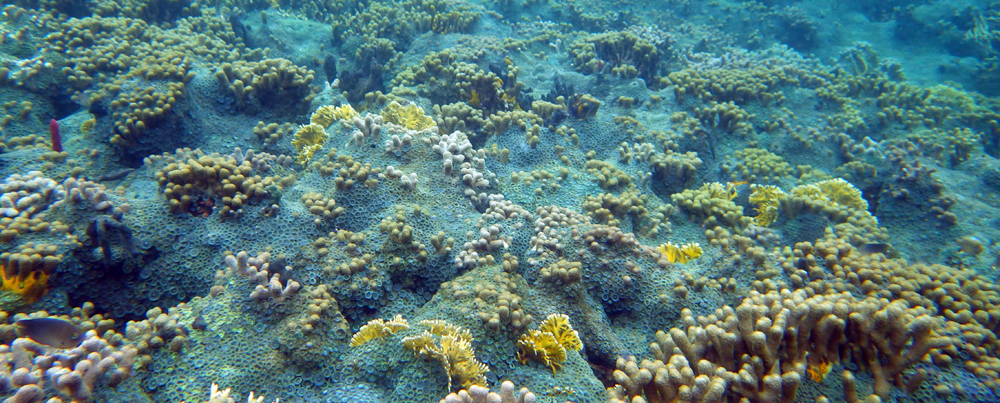
| The reef shallows at Punta Cocos |
This morning the class went on its last snorkeling trip away from the marine
station. First we visited a new spot, a patch reef near Punta Cocos (Isla
Cristobal) - this was our eleventh location to snorkel on six days of organized outings.
In the shallows, the reef was a patchwork of
finger coral (
Porites) and fire coral (
Millepora alcicornis), intermingled with bright turquiose zoanthids (
Zoanthus pulchellus), and
sponges.
 |
| Closeup of corals, sponges and zoanthids A damselfish and its algal turf farm |
The blue-green sheet of zoanthids surrounded emergent coral colonies and sponges. No open space was to be found on this carpet. Brittle stars with their long, spikey arms lounged on the
sponges and other highspots, or draped the bottom. The shallows also were bustling
with damselfish constantly darting out to guard their territories of turf algae
that they farm for a living. These plots attract roving fish grazers that try to get a free lunch.
 |
| Staghorn coral (Acropora cervicornis) and fishes |
A little deeper we saw several small stands of
staghorn coral (
Acropora cervicornis) which made safe havens for a variety of other
fishes. Also deeper were the occasional gorgonian (octocoral)
"trees", mounds of brain coral, and pot-bellied sponges decorating
the sand and coral rubble bottom.
The
visibility was excellent, the sea calm, and the snorkeling great.
 |
| A redband parrotfish (Scarus aurofrenatum) |
Later we re-visited Hospital Point (on Isla Solarte) where lots of fish
grazed and browsed. My favorites are the parrotfish that clip the turfs,
crop the algae, and scrape the coral- producing lots of carbonate sediments.
The students have grown ever more comfortable in the water, with
buddy-pairs wondering out, no longer clustered in a group of 10. We have
developed an efficient snorkel routine; everyone shares his or her discoveries
below as well as above the water.
Over our time here we have snorkeled on
fringing reefs, patch reefs, in seagrass meadows on the reef flats, and we have
explored the mangrove root communities that line the shore of these emerald
islands. The class has explored a swath of reefs distributed over more than 30 kilometers of the Bocas ocean. Students have experience data
collection as a group and have worked hard on their planned projects that
culminate tomorrow.
 |
| Map of Bocas region and general location of our outings |
The second offering of this OIMB field course “Tropical Marine Biology in Panama”
has gone very well. The
students’ enthusiasm has remained high; their focus on the living organisms
above and below water has been sharp; their interest in this tropical and
Panamanian experience has been substantial.
The class has been an excellent one to co-lead. In preparation for the
class, I have enjoyed my summer reading about Tertiary and Quaternary coral
reefs, climate change, sea level, and species turnover in reef systems.
My co-instructor, Jan Hodder has been a
pleasure to work with again.
The
students have represented OIMB and the University of Oregon extremely well, and
I am delighted to have had the opportunity to bring them to Panama in
2015.
The hard working research teams -
“Damsels in Distress”,
“Cucumber Crew”,
and “Go with the Flow” are on the home stretch and I look forward to their
research presentations and posters.
Great job students!
Hasta mañana,
Richard (Emlet)