Tuesday, September 10, 2013

Adventure to Bastimentos!


Inside Bastimentos Island National Marine Park
I’ve grown more comfortable with the sound of rain pounding on our tin roof in the middle of the night.  In fact, if it weren’t for the thunder and lightning that accompanied our little rainstorm last night, I might not have woken at all.  I almost thought it was a dream, until my classmates mentioned the event during breakfast – which consisted of bacon, coconut bread, cheese, and bread fruit.   The latter is quite starchy, and tastes a lot like patacones when fried up and served with salt.  Fortunately, a midnight rainstorm in the tropics does not equate to all day showers, as it might in the Pacific Northwest.  Today was rather beautiful and sunny, with barely a cloud in the sky – perfect for an all day trip to the Bastimentos Island National Marine Park, just about a 40 minute boat ride from the Smithsonian Tropical Research Institute. 
Queen Angelfish

Our first exploration site was further from land than any of our previous sites, calling for a safety brief from Ricardo (Richard) on conserving energy while swimming in strong ocean currents and the hazards of waves breaking on the fore reef.  What passes for “choppy” in the Caribbean could easily be considered a calm day in the Pacific, but that doesn’t make it any easier to swim through.   While the currents were a bit stronger than we have been accustomed to, experiencing the magnificence of the reef was well worth it.  
Blue Tang and Ocean Surgeonfish aggregation

The very real fear of brushing against fire coral while entering the water disappeared as each of us jumped from the Scarus and easily situated ourselves out of harm’s way.  Just off the boat, I came across a couple of Queen Angelfish – brilliantly blue with yellow pectoral, ventral, and tail fins.  One of the most noticeable sights was the large aggregations of Blue Tang, Ocean Surgeonfish, and Doctorfish roaming the reef, grazing on algae.  In fact, this particular reef seemed to be teeming with fish, large and small, some of which I have never seen before.  A Whitefin Sharksucker – of the Echeneidae (Remora) family – approached my buddy, Theresa, and I in an attempt to attach itself to one of our bodies.  The only way I could think to describe it to our group was as a “small sea dragon”, but fortunately I had taken enough pictures for Richard to identify it as a Remora.
Whitefin Sharksucker
Making our own bubble ring.
We have been on the lookout for a good spot to take a picture of everyone “throwing up the O” while snorkeling, and today Richard came up with a great way to show our Oregon pride from the Caribbean.  Without any previous synchronized swimming experience, we were able to form a large O by linking arms, giving us the freedom to form smaller O’s with our own hands.  As much fun as it was defying the ocean currents to maintain a ring of students and professor, I’d say the most exciting part of our trip to Bastimentos was a double shark sighting.  On the way back to the boat, there was a Nurse shark, easily visible from the surface of the water, hanging out in a crevice in the rock.  It must’ve been almost 8 feet long!  However, the Hammerhead shark we sighted on the way to our lunch spot was much bigger and definitely stole the show. 

A Young Coconut Tree
Nurse Shark
Just before lunch, we anchored near Zapatillos - a small island of fine, white sand and coconut trees, surrounded by some patches of coral reef.  A couple of park rangers came to collect our fees for using the island.  The beach is used as a nesting site for sea turtles, and the park fees are put towards protecting the sea turtles from poachers and disturbances – as well as preserving a sample of marine and coastal ecosystems.  Unfortunately, we have yet to see a sea turtle in the wild, but it is nice to know that there is an effort being made to restore the local population. 

While we waited for lunch time to come around, some of us snorkeled off the boat, and a few of us explored the island.  Leave it to Oregonians to go looking for a “forest” in the middle of the ocean.  The trees were all palm and coconut, and it was neat to see coconut trees sprouting from the fallen fruit.Sitting in the sand with the aqua blue waves lapping at our feet was like living in a postcard, and we certainly discussed being happily stranded on one of these beautiful islands. 
 
Moon Jelly
After lunch, we took a ride to Coral Cay, which began to feel like a jellyfish mine field after about 30 minutes.  It’s a good thing Aurelia aurita (Moon Jellies) aren’t dangerous, or we might have been more worried about dodging the jellies than checking out the other interesting fauna.  This included a variety of sponges, corals, and fish, brittle stars, and sea urchins. When we got back to STRI, we washed the sand and salt from our skin and hair, grabbed some coffee, and enjoyed a lecture on corals through history, with Richard Emlet.  After a dinner of pork chops, mashed potatoes and veggies, some of us were ready to jump back in the water for a night snorkel, while others sat down to write in our journals and update the blog :).

- Kassie Quackenbush
Warty Corallimorph

Bearded Fireworm
Sponge Brittle Star

Saturday, September 7, 2013

Research Time!

Today marks the halfway point of our Panama trip. It is going by so fast! Since spring term we have been working on group research projects that focus on the marine ecology of multiple habitats in the Bocas del Toro area here in Panama. Since then, there has been some group personnel and project changes but the details seem to have been smoothed out and we were ready for action this morning. It was our first chance to work independently as scientists without having our professors hovering over us. This, however, didn't stop the constant questioning from Will and I concerning our project. After breakfast everyone strapped on their snorkeling gear and headed out into the water.

Robbie, Susanna, and Kristi aimed for the sea grass meadows. Their project is focusing on the gradients of epibiont grazing and herbivory with distance from the mangroves as possible contributing factors to the amount of epibionts as well as sea grass shoot density and height.


Robbie and Kristi working in their quadrat
The original idea was that the gradient was caused by juvenile fish that use the mangroves as a refuge, but upon further observation there are more variables that may attribute to this phenomenon. Some of the potential grazers are juvenile Grunts, juvenile Threespot Damselfish, the Slippery Dick fish, and a variety of snails. The main herbivore in the area is the Bucktooth Parrotfish.


Sea grass with a bite mark and epibionts
 Today the group measured out their 20m transects and set up their permanent quadrats.They counted the amount of sea grass shoots in each transect and collected five of the shoots to bring back to the lab to scrape off the epibionts and weigh them. 
Christy and Mandi are well prepared!


Christy's and Mandi's hypothesis is that because mangrove prop roots are a day time refuge for juvenile fish to avoid predation from visual predators, there will be a greater abundance of fish during the day than at night.
Also, while seeking refuge the fish will display more resting behavior than feeding behavior. To measure this the group stretched three 15m transects parallel and adjacent to the mangrove prop roots.
 They record both the species and the abundance of the fish as well as the behaviors of the fish. They will sample both during the day and during the night to observe the differences.
A large school of herring in the mangroves


Theresa and Kassie are focusing on the behavior of the highly aggressive Threespot Damselfish. They are looking at the differences in aggression between individuals that maintain territory on continuous reefs and isolated patch reefs. This aggression can be both interspecific (between species) and intraspecific (within species), and these interactions will be recorded. The hypothesis is that since continuous reefs are more complex and contain more species that the damselfish with exhibit greater interspecific aggression.
Juvinille Threespot Damselfish
 Today the group searched for territories suitable for observations and recorded baseline data of the territories. They are quantifying the fish behavior using an ethogram. An ethogram is a list of behaviors that are defined from observations, and in this case scholarly sources, and then during sampling they record the number of times the behavior occurs.

Will and I went straight to the coral and are working dangerously close with the stinging fire coral, Millepora alcicornus. We are trying to  correlate both micro- and macro-morphology with the flow rate of the water. Micro-morphology is quantified by polyp density and macro-morphology is quantified by branch diameter, branching rate, and branch fusing.
Today we found three samples with differing morphologies and used two methods to measure the flow of water in the vicinity; fluorescein dye and clod cards. A meter stick was placed adjacent to the sample fire coral at the .5 meter mark and the dye was injected near the same point, measuring the time it took to travel .5 meters. Then we placed two clod cards made of plaster adjacent to the sample which we will retrieve after ~20 hours. The higher the flow the faster the clod cards will dissolve thus giving us a comparable measure of flow rate.
High flow morphology with fluorescein dye

Low flow morphology of M. alcicornis


 Question: Did you run into any problems today?
Susanna: "Yes, setting up the transect lines under water is harder than it looks. Water is fluid."
Mandi: "Yes, the massive schools of herring makes it hard to see any of the fish behind them. You have to see through them."
Kassie: Yes, initially finding the right depth of samples so we don't intrude on their [damselfish] territory and alter their behavior."
Willie: "Not really, the environment was variable so we had to adapt."


Question: What are the potential dangers of working on your project?
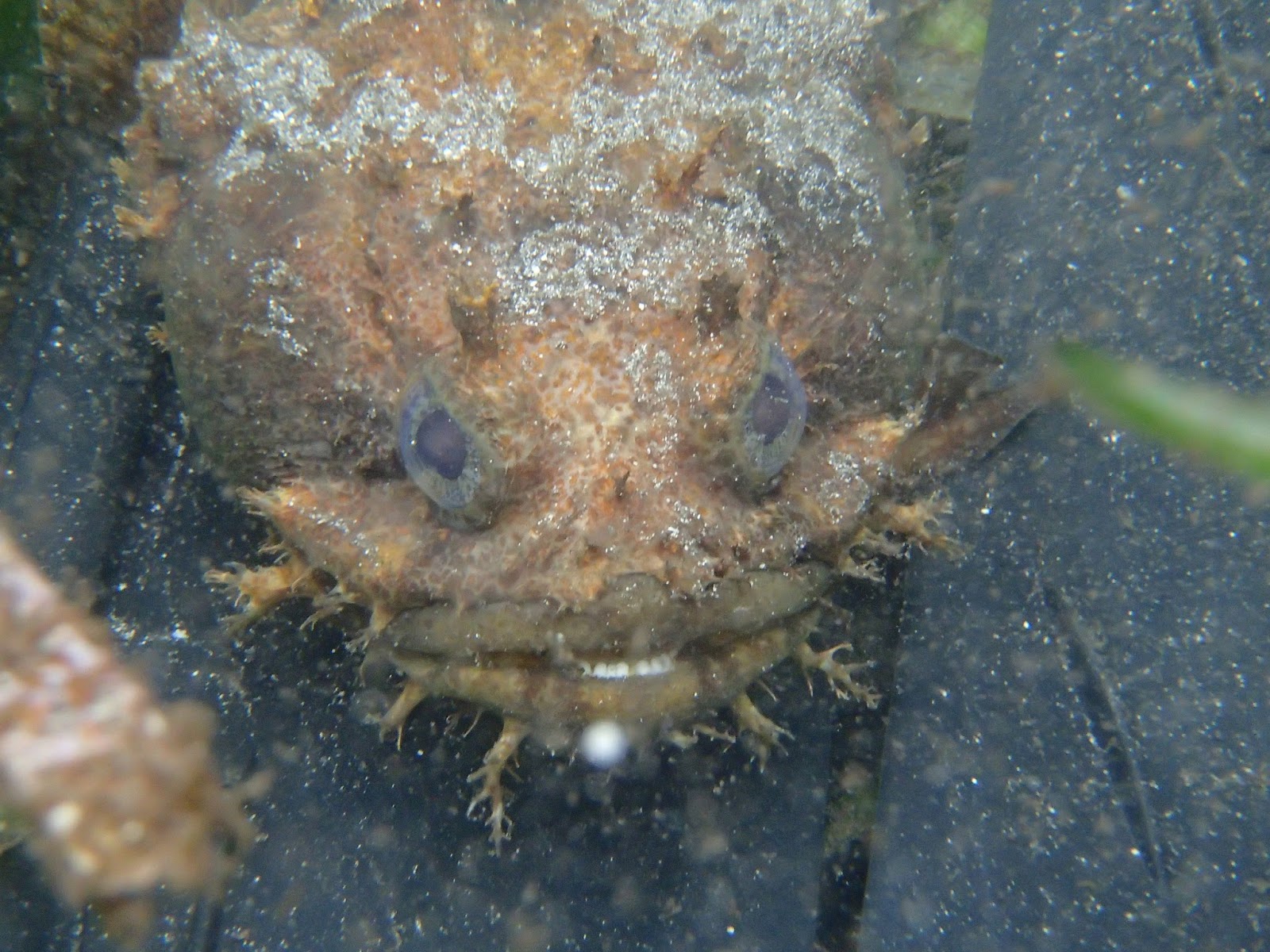
Kristi: "Stepping on a Toadfish."
Mandi: "Box jellies, we avoided quite a few of them!"
Theresa: "Getting attacked by the damsel fish that are protecting their territory."
Willie: "Getting burnt to hell on the fire coral."
A Toad Fish laying comfortably on a dive fin.


 Question: What was you favorite part of being in the field today?
Susanna: "Seeing Toadfish and Cassiopea. Crazy!"
Mandi: "The Ragged Sea Hare, we had no idea what it was at first."
Theresa and Kassie: "A Balloon Fish!"
 Willie: "Seeing the variation in fire coral on a single reef point."


A Ragged Sea Hare
  The Balloon Fish


After a long day of stepping out into our projects we reigned in September 7 with a somewhat depressing seminar on coral reefs. Here in the Caribbean there has been an 80% decline in coral cover in the last 30 decades. This same trend is consistent in the majority of the world's coral population. This decline is caused by a combination of climate change and human influences such as removing large apex predators and nutrient runoff. Increasing ocean temperatures stresses the corals and makes them expel their symbionts, zooxanthellae. Removing the large apex predators increases the pressures induced by grazing fish and decrease growth of the corals. The nutrients that are added to the oceans are utilized by the better competing algae which will cover the coral and prevent food and light from reaching it. Protecting the reefs we have now is the most cost effective method for conservation, but will only buy us a couple decades. Hopefully by then there will be a shift in the view on the importance of coral reefs or it will be an ecosystem that will have faded into the past.

On a happier note, we have the day off tomorrow. Most people are planning on sleeping in, relaxing, and exploring the local town. Aside from that the plans include hiking, swimming, and working on our projects!


-That's me Jaron Bowton

Holy Cacao We're Going Bananas!!!

Before you read this blog entry you have to ask yourself one question: How much do I really want to know about bananas? I really hope your level of excitement is something like this:


... And I'm going to assume it was! Today we  found out that we did not know very much and there is a WHOLE HECK OF A LOT more to learn about that curiously sickle shaped fruit you probably had for breakfast.

Our day started out with a boat ride from the STRI dock to Almirante on the mainland, from which we boarded a van and made our way towards the banana plantation and packaging plant. The farm (finca) and packaging plant were located on the border of a small town known as Changuinola. The finca is currently run under fair trade rules, where previously it was owned by a large distributing corporation. Upon arriving to the farm we were all ready to get out and explore.
In the van top to bottom, left to right: Jaron Bowton, Cassie Quackenbush, Robbie Mcnulty, Theresa Berkovitch; Susanna Debell, Christie Ellison, Mandi Cromar; Richard Emlet, and Christy Stumbo. Our two friendly translators on the right: Lena y Carlos!
The first thing that struck me was how colorful the wall-art of the buildings was, as well as the beauty of the natural setting.
Tributary to Rio Changuinola

Christie Ellison with an Immature guanabana fruit!
We were lucky enough to have Alexander as our knowledgeable guide for the day, and he walked us to the crop fields where we began our journey down the rabbit hole. It really is quite the rabbit hole, so strap in and hang on.
Theresa, Susanna, and Robbie heading the pack, with Alexander on the far right
Christy posing with the banana grass
First! A banana plant is not a tree, but a grass and as such one plant is actually grown from a shoot borrowed from a previous plant. In fact quite frequently another shoot will begin to sprout from the base of one that is already standing, the "mother". This characteristic is used to propagate the crop without replanting after each harvest.
Cassie posing next to a chopped shoot that is being preserved for cloning

Alexander thinning the new shoots to reduce nutrient competition.
 As the
majority of the shoots on the crop field are related to each other they are rather susceptible to disease, as most monocultures are. To account for this, fungicides are released over the fields by helicopter.
A leaf being attacked by a fungal disease.
When these new shoot sprout they mark the next generation of banana plant, and will be able to fruit after nine more months. Once the flower begins to produce fruit, how to harvest that fruit becomes a BIG question. Turns out harvesting is a two person job, one to prepare and lower the "hand" of bananas, and the other to receive and carry it.
A banana flower!

Cutting down the shoot to bring the banana hand to a manageable level


Mandi watches as the hand is placed on the "hook and line" system to reduce carrying time.


 Any hand can hold 80-100 bananas and weigh up to ~125lbs!!! The hand is then hooked onto a wire cable, along with a good many others and taxied to the packaging plant by a man on the back of a donkey.
Jaron displays this stellar hand of bananas.


One bad banana...
At the packaging plant the hands undergo inspection looking for bad bananas. Unfortunately, one bad banana means one bad hand of bananas. The quality control is quite scrutinous.
 The hands that survive the inspection go on to further processing, namely sizing and washing. The workers break the hands down to an appropriate size for the market, and then place them in a conveyer bath contraption that washes them and moves them further along towards the packaging. Finally the boxes of copious bananas are loaded into trucks for international and national distribution.


Susanna gives packing some bananas a try.

The label on the final product. Va a Alemania!!(Germany)
Each box bought through fair trade is four dollars more than one bought by a corporate distributor.
Upon seeing the long and eventful process of having a banana and receiving a box of bananas for the road we made our way back to Almirante to meet Christiano with the boat. Before we made our way back to STRI we stopped at a certified organic Cacao finca on the far side of the Isla de Colon.
  We were kindly greeted by the foreman,Timothy Brown, who brought us up from the mangroves to the processing building. There we received a brief introduction from Calvin who then led us on a tour through the cacao laiden rainforest where we viewed a lot more than we bargained for. Not only did we get to see multiple ages of cacao plants and the varying ripeness of the pods (containing the valuable seeds!), but a wide variety of trees, plants, wildlife, and fungi!!!
Calvin provides a brief history, and explains what they do on the finca.
Before I get too carried away with the bonus findings of the trip, a few facts about the cacao and it's history would seem appropriate. Its delicious and valuable qualities were first recognized by the Mayans and Incans, who would dry it in the sunlight before further use (Nope, it wasn't Willy-Wonka, sorry.) Before the cacao seeds get dried this is what they look like:
Three cacao fruit pods; the most left is ripe.
A less than 3 year old cacao tree.


A cracked and delicious cacao pod, containing seeds(the beginnings of chocolate) and the tasty substance covering the seeds.
The tissue that they are surrounded in is DELICIOUS and a little strange. They're a lot like a Mentos, take one and pop it in your mouth and hang out with the flavor for a while, just try not to swallow one whole. While the cacao is most famous for the world renown confection, chocolate, the plant lends itself to other uses as well. The skin of the pod, if scraped off and turned into a pulp can be used to help clot blood if placed on a wound. The tree itself provided the simple pleasure of shade, which I can personally attest was in dire need by that point in the day.

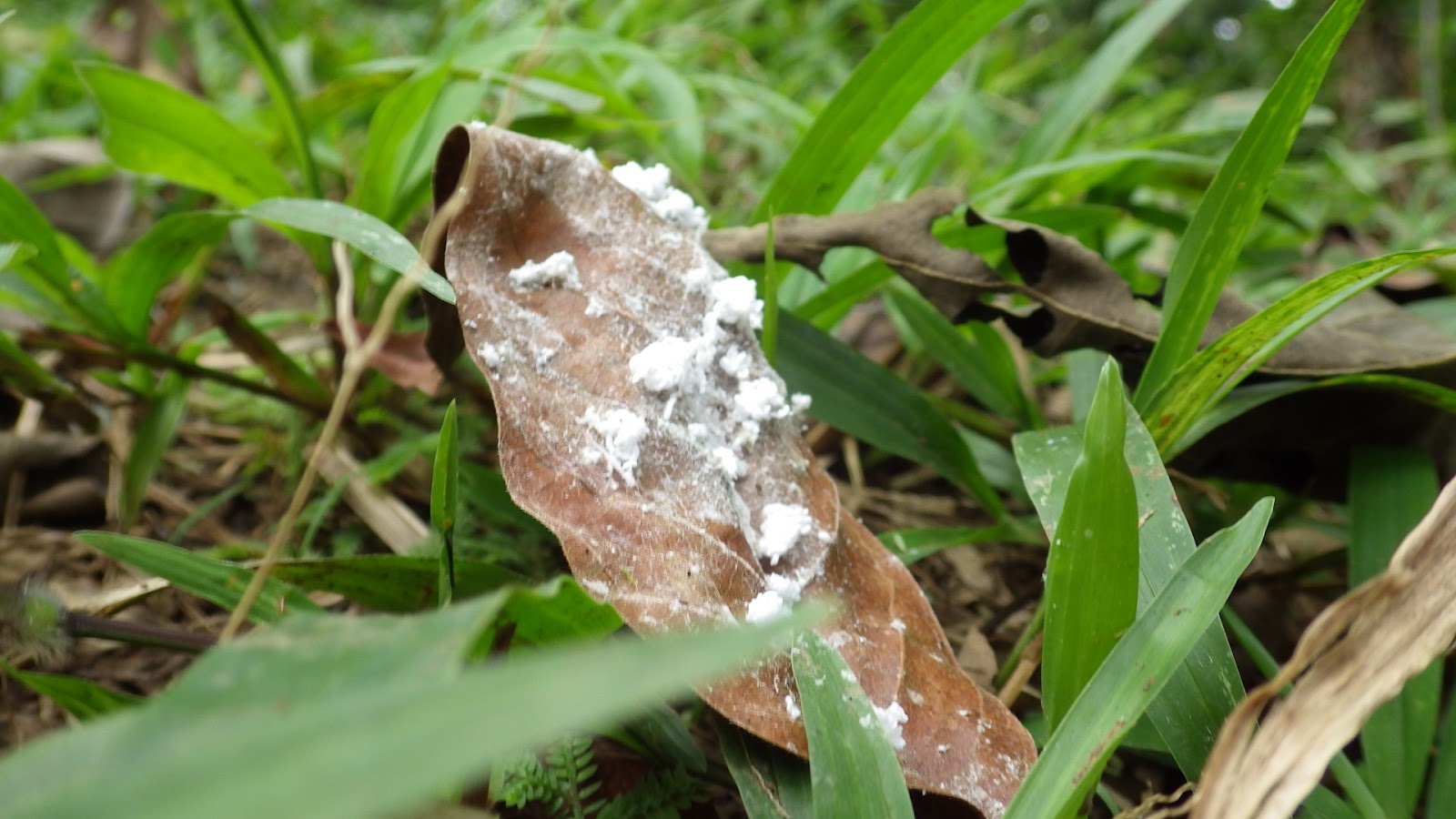
Aside from the wonders of the cacao we learned of, a number of other interesting biological items were found during our walk through the eden that was Calvin's day to day setting:


All in all September 6, 2013 was a really good day for the OIMB crew in Panama. We certainly learned more than we planned with regards to those yellow delights and were pleasantly surprised by what lay inside the pods of the cacao plant. People got hot, then sweaty, tired, and almost irritable at points through the day, but we all came out of there with smiles and light hearts. Good job team!
The whole crew! Including Timothy Brown.

The blogger, Willie BotPo!
Hasta luego!!